Using Mind Maps to Organize Puzzle Solutions Efficiently
Unlocking the Puzzle-Solving Potential
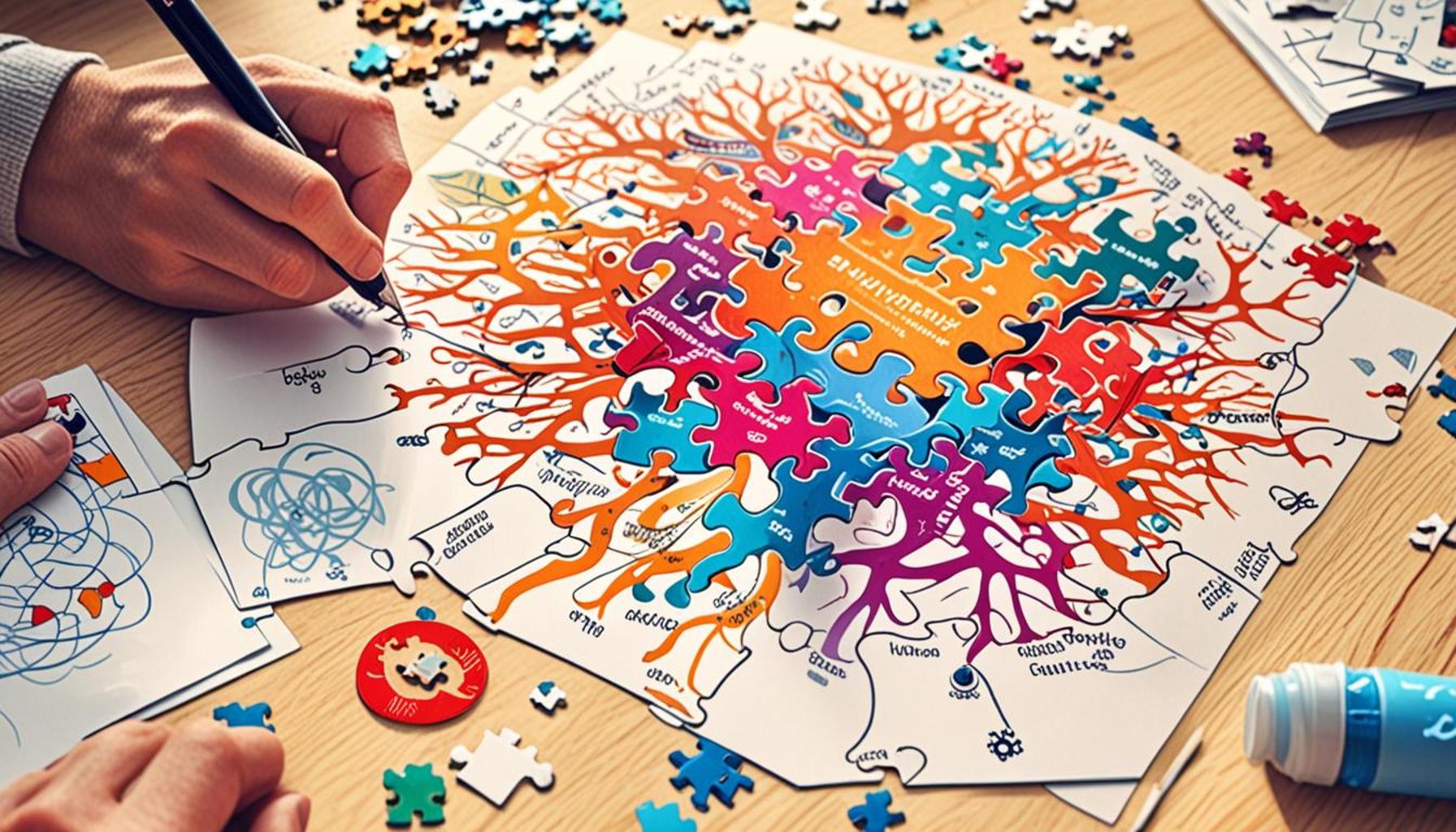
Puzzle enthusiasts often find themselves in a tangled web of solutions and strategies. The complexity of puzzles can lead to frustration, especially when trying to organize thoughts and approaches. Fortunately, utilizing mind maps provides a clear and effective method to streamline the process, enabling solvers to visualize their thoughts and tackle challenges systematically.
Mind maps foster creativity and organization, turning chaotic ideas into structured visuals. This unique technique can be particularly beneficial, offering several advantages for those eager to enhance their puzzle-solving skills, including:
- Visual Clarity: Mind maps simplify intricate concepts or multifaceted strategies by presenting them in an easily digestible format. For example, a large crossword puzzle can be systematically broken down into smaller interconnected clues, highlighting relationships between them.
- Enhanced Memory: Studies suggest that visual learning techniques, such as mind mapping, improve retention of information. By associating images and keywords with puzzle components, solvers are more likely to recall details and connections relevant to the challenge at hand.
- Flexible Structures: Mind maps are inherently adaptable, allowing users to make easy adjustments or additions as they progress. If a new idea arises or insight occurs, it’s straightforward to integrate these into the existing map without losing the overall structure.
For puzzle solvers, mind maps function as a dynamic tool that adapts to various challenges. Whether working on crosswords, Sudoku, or intricate logic games, mind maps can empower users in the following ways:
- Organize Steps: Deconstructing a puzzle into manageable parts transforms an overwhelming task into a series of achievable steps. For instance, in a logic puzzle, one can visually outline the clues and how they relate to one another, making it easier to draw logical conclusions.
- Track Progress: A mind map allows solvers to visually represent what has been solved and what remains unanswered. This tangible representation can motivate individuals by providing a clear sense of advancement through the puzzle-solving journey.
- Explore Alternatives: Brainstorming different approaches to a problem becomes more accessible when using a mind map. Solvers can jot down various strategies alongside their potential outcomes, leading to innovative solutions that might not have been considered otherwise.
As solvers engage with puzzles, utilizing mind maps not only aids in clarity but also significantly boosts problem-solving skills. This innovative approach encourages individuals to think deeply and outside the box. It sets the stage for efficient and enjoyable puzzle-solving experiences, turning what could be a frustrating endeavor into an engaging activity that stimulates the mind. Moreover, with the widespread popularity of puzzles in American culture—ranging from Sunday newspaper crosswords to competitive escape rooms—embracing these visual techniques could enhance the experience for many. As puzzle-solving transforms from a lonely task into a collaborative and thoughtful journey, mind maps might just be the key to unlocking hidden potentials.
CHECK OUT: Click here to explore more

Transforming Complexity into Clarity
As puzzle enthusiasts tackle increasingly complex challenges, the need for efficient strategies to organize thoughts has never been more critical. Utilizing mind maps presents an innovative solution to streamline problem-solving efforts. These visual tools help break down convoluted puzzles into comprehensible segments, thus enhancing the overall experience.
One of the most significant technical advantages of mind mapping lies in its capacity to illustrate relationships between various elements of a puzzle. For instance, when working on a challenging Sudoku grid, a solver can create a mind map that highlights potential placements for each number. This not only assists in tracking numerous number possibilities but also allows for a clear visual representation of how different placements affect each other. Rather than relying on memorization alone, solvers can see the links and dependencies that exist between the numbers, paving the way for more insightful decision-making.
Effective Problem Deconstruction
Deconstructing puzzles into smaller, manageable components is essential for effective problem-solving. Mind maps encourage this approach by enabling solvers to outline steps visually. By breaking down a jigsaw puzzle, for example, one can categorize pieces by color, shape, or edge pieces versus interior. This organization not only speeds up the assembly process but also minimizes frustration, as solvers can focus on specific categories rather than becoming overwhelmed by the entire heap of pieces.
Mind maps also allow solvers to track various strategies concurrently. This feature is particularly beneficial in competitive settings, such as crossword tournaments, where time is of the essence. Solvers can branch out from the main topic—like the central crossword grid—and note potential answers, synonyms, or themes for clues, creating a web of associations to draw from as they fill in the puzzle. This holistic perspective not only aids in enhancing speed but also fosters creative thinking, as solvers begin to visualize connections that may not be immediately evident.
Visualizing Progress and Motivation
Another important aspect of utilizing mind maps in puzzle-solving is their role in tracking progress. By representing both solved and unsolved components visually, solvers can maintain motivation throughout the process. For example, when confronted with a series of challenging riddles, a mind map can illustrate which riddles have been successfully solved and which still require attention. This visual acknowledgment of progress serves to encourage continued engagement, transforming a tedious journey into a rewarding challenge.
In competitive scenarios, where preserving momentum is crucial, visual progress indicators can also help solvers decide when to shift focus or try alternative approaches. This adaptability is particularly pertinent in settings like escape rooms, where time constraints make efficiency a priority and quick thinking is essential.
In conclusion, the utilization of mind maps offers a multifaceted approach to organizing puzzle solutions efficiently. From fostering clarity in the face of complexity to visualizing progress, these innovative tools truly have the potential to enhance not only the solving process but also the overall enjoyment of puzzles.
Using Mind Maps to Organize Puzzle Solutions Efficiently
As puzzles become increasingly complex, the necessity for efficient organization methods also rises. Mind mapping is an engaging technique that allows puzzle enthusiasts to visualize connections, facilitating problem-solving. This methodology not only enhances creativity but also ensures that every aspect of the puzzle is addressed in a comprehensive way.
| Category | Advantages |
|---|---|
| Visual Learning | Mind maps leverage visual cues, aiding in quicker understanding and retention of puzzle components. |
| Improved Focus | This method minimizes distractions and allows for targeted problem-solving, which can be valuable during intricate puzzle-solving sessions. |
Moreover, using mind maps helps in breaking down complex puzzles into smaller, manageable parts. By doing so, solvers can prioritize tasks, identify patterns, and direct their efforts more effectively. Each connection on the mind map represents a potential solution or a pathway towards resolving a challenging aspect of the puzzle. Such a structured approach not only enhances productivity but can also boost confidence, as it clearly delineates the steps taken towards finding a solution.
With the increasing accessibility of digital tools, creating and sharing mind maps has never been easier. People can collaborate on puzzles, sharing their maps to gain different perspectives. This collaborative effort fosters community engagement and strengthens the engagement among puzzle enthusiasts, further enhancing the overall experience.
CHECK OUT: Click here to explore more
Enhancing Collaboration Through Collective Mind Mapping
In addition to streamlining individual problem-solving, mind maps can also foster collaboration among groups engaged in puzzle-solving activities. By utilizing shared mind-mapping platforms, teams can brainstorm collectively, thereby pooling their insights and strategies. This technique proves particularly effective in settings like classroom learning or puzzle clubs, where diversity in thought often yields more creative and diverse solutions.
For instance, in an educational context, instructors can have students engage in collaborative puzzle-solving sessions using mind maps to structure their ideas. Students can tackle a complex logic problem or riddle by contributing different branches to a collective mind map, which allows them to visualize all potential angles to the solution. This practice not only enhances individual understanding but also builds teamwork skills as students learn to value different contributions and perspectives.
Facilitating Memory Retention and Recall
Another compelling advantage of using mind mapping within the realm of puzzles is its ability to enhance memory retention and recall. By incorporating imagery and color, mind maps can help solvers better remember critical elements of a puzzle. A well-structured mind map can function almost like a cognitive anchor, creating a mental image that aids solvers in recalling information when they need it most.
Research suggests that visual learning techniques, including mind mapping, can significantly improve information retention. Therefore, when tackling complex crossword puzzles or intricate riddles, solvers can devise a mind map that integrates visual cues alongside textual information. Color-coding various clues or using icons to represent specific strategies within the map can create a more engaging and memorable learning experience. This strategic layering reinforces conceptual understanding, transforming abstract clues into tangible, recognizable parts.
Incorporating Technology into Puzzle Solving
As the digital age continues to advance, tech-savvy puzzle enthusiasts are discovering various applications that enhance mind mapping capabilities. Tools such as MindMeister and XMind allow users to create dynamic and visually appealing mind maps with relative ease. These platforms not only provide an intuitive interface but also offer features such as collaboration, multimedia integration, and cloud storage. This means that solvers from various geographical locations can work together seamlessly, accessing and updating the mind map in real time.
The incorporation of technology into mind mapping for puzzles also enables solvers to store a plethora of solved puzzles in an organized fashion, creating an archive of strategies and insights for future reference. This electronic repository reinforces the idea that solving puzzles is not just an individual pursuit but can be enhanced through shared resources and collective experiences.
Adapting Mind Maps for Different Puzzle Types
One of the most versatile aspects of mind maps is their adaptability across different puzzle types. From logic puzzles to word games, the structure of a mind map can be modified to fit the unique demands of each challenge. For example, while tackling an escape room puzzle, solvers can design a mind map that categorizes clues based on rooms, objects, and interactions, allowing them to problem-solve in a systematic manner. Alternatively, for riddles or brain teasers, solvers can branch out possible interpretations, synonyms, and related concepts, enhancing their creative input.
This flexibility in application facilitates personalized approaches to puzzle-solving, allowing solvers to focus on the techniques and strategies that resonate most with their understanding. Thus, the resulting mind map will not only serve as a functional tool but also as a reflection of the solver’s unique perspective, effectively catering to individual needs and styles.
SEE ALSO: Click here to read another article
Conclusion: Unlocking the Potential of Mind Maps in Puzzle Solving
The utilization of mind maps as a strategy for organizing puzzle solutions is a testament to the intersection of creativity and logic. By embracing this visual tool, solvers not only enhance their individual problem-solving skills but also cultivate an environment conducive to teamwork and collaborative thinking. The flexibility of mind maps, whether applied to logic puzzles, crosswords, or brain teasers, opens avenues for personalized approaches that cater to various cognitive styles.
As we have explored, the incorporation of technological advancements such as app-based mind mapping platforms further enriches the puzzle-solving experience. Accessible tools like MindMeister and XMind empower users to collaborate in real-time while building a digital archive of clues and strategies that can be revisited in future challenges. This not only minimizes the learning curve but allows puzzle enthusiasts to tackle increasingly complex problems with confidence.
Moreover, the marrying of visual strategies with auditory and kinesthetic learning styles facilitates better retention and recall, ensuring that crucial elements remain etched in memory. Engaging with mind maps in both individual and group contexts transforms the puzzle-solving journey from a solitary endeavor into a shared adventure full of innovative solutions.
Ultimately, whether you’re an educator looking to inspire students or a puzzle aficionado aiming for efficiency, mind mapping stands out as a compelling approach. As you delve deeper into this technique, the potential for clarity, creativity, and collaboration will undoubtedly enhance your puzzle-solving pursuits. Consider embracing mind maps not merely as tools, but as gateways to a more organized and engaging problem-solving experience.